Explainable AI Agents: Explaining Decisions, Not Just Models
Classic explainable AI explains model features. AI agents need more: what they claimed, what evidence backed it, and which rules they were checked on.

Contents · 6 sections
Explainable AI grew up explaining single predictions. Why did the credit model score this applicant low? Feature importance methods like SHAP and LIME answer that by showing which inputs pushed the score up or down.
AI agents don’t make a single prediction. They plan, call tools, read live systems and chain decisions over many steps. Explaining them takes a different approach, and that approach decides whether risk teams will ever let agents run on their own.
Why classic explainable AI doesn’t fit agents
- Many steps, not one. A wrong decision at step 12 often starts with a bad assumption at step 4. Explaining only the final output misses it.
- Tools and data, not just features. An agent’s decision depends on what its tools returned, or failed to return. Feature weights inside a language model say nothing about that.
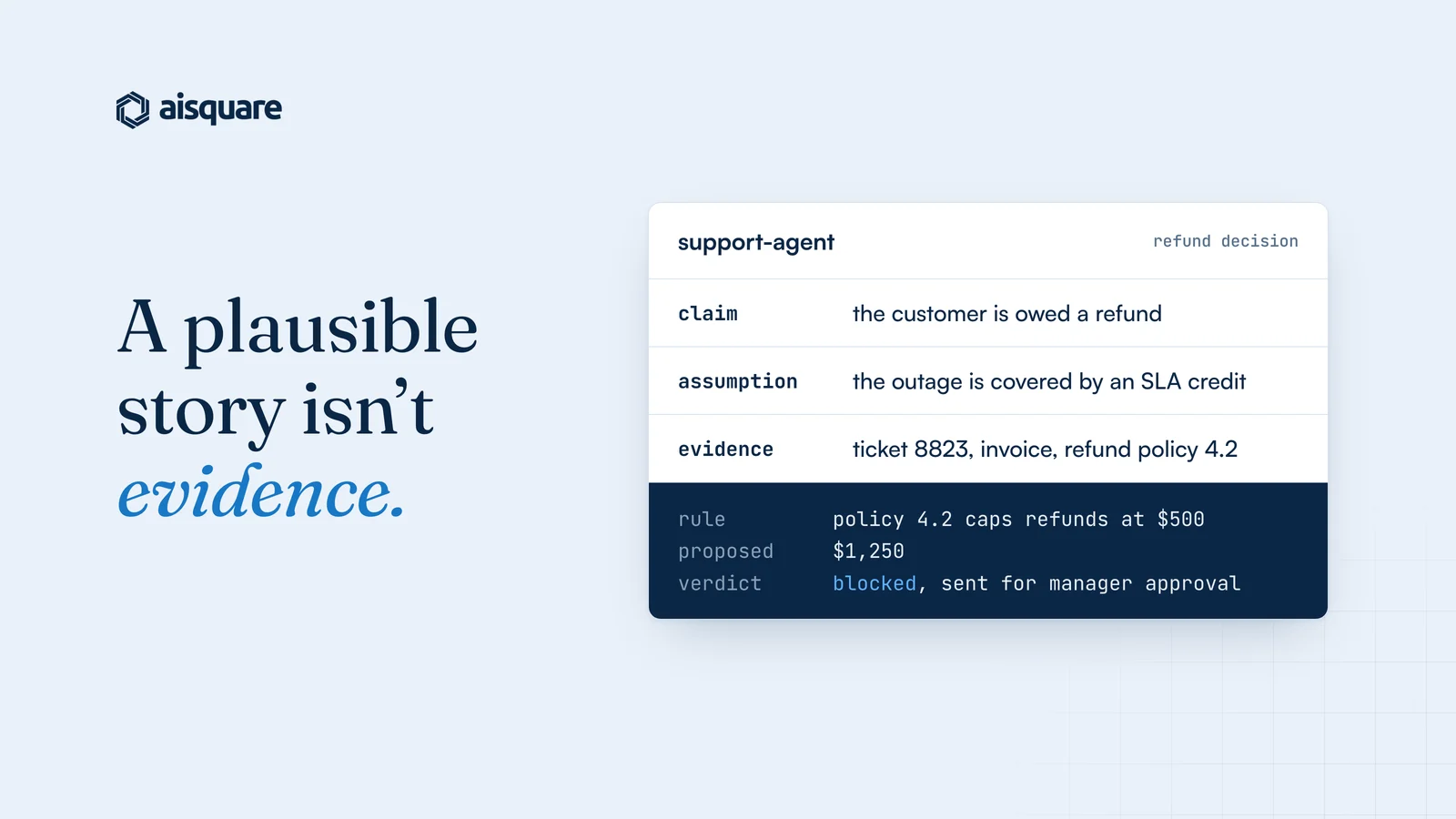
- The model’s own reasoning text isn’t enough. Agents can produce reasoning that reads well but doesn’t match what actually drove the answer. A plausible story isn’t evidence.
- The audience is different. A compliance officer doesn’t need token-level attributions. They need to know whether the decision was right, allowed and provable.
What a useful agent explanation contains
A useful explanation for an agent decision answers six questions:
- What did it decide?
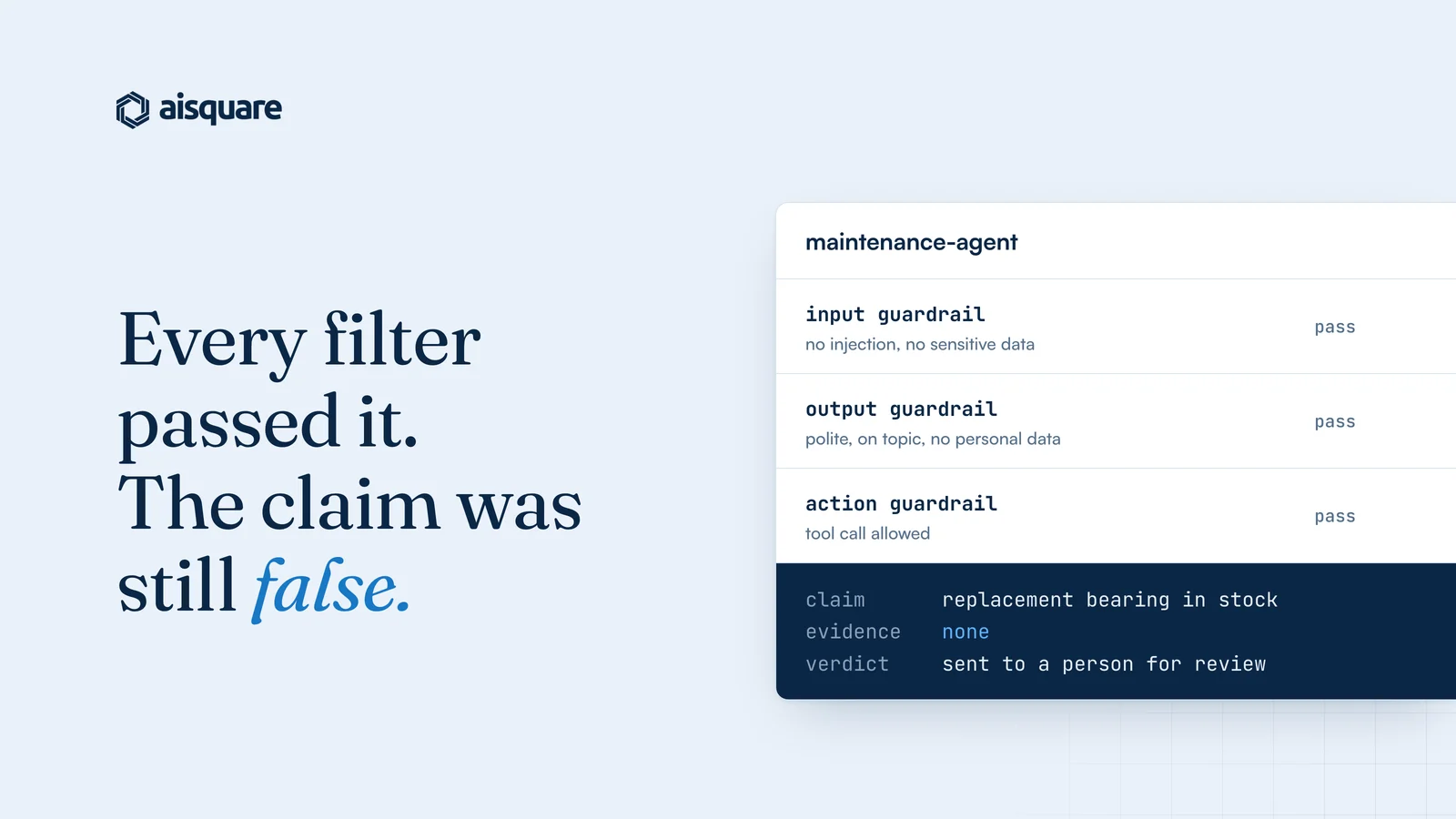
- What did it claim was true?
- What did it assume without checking?
- What evidence backed each claim, and which claims had none?
- Which rules was it checked against, and did it pass?
- Who reviewed it, and what did they change?
Here’s a simple example from a customer support agent:
- Claim: the customer is owed a refund.
- Assumption: the outage is covered by an SLA credit.
- Evidence: ticket 8823, the customer’s invoice and refund policy 4.2.
- Rule check: policy 4.2 caps refunds at $500. The agent proposed $1,250, so the decision was blocked and sent for manager approval.
Anyone reading that, from an engineer to an auditor, can see what happened and why.
One decision, four audiences
| Audience | What they need | What to show them |
|---|---|---|
| Engineers | Where it went wrong | The trace plus the claim that failed |
| Domain experts | Whether the reasoning holds up | Claims, assumptions and evidence, with a way to correct them |
| Auditors and regulators | Whether it can be proven | A signed record of the rules checked and the outcome |
| Affected customers | Why they got this outcome | A plain-language summary |
The same structured record can serve all four. Unstructured logs serve none of them well.
An explanation should lead to a fix
Explaining a bad decision is only half the job. If an expert reads the explanation, spots a flawed assumption and nothing changes, the next run makes the same mistake, and reviewers slowly stop paying attention.
The better loop is that the expert corrects the reasoning, the correction becomes an approved rule, and every relevant agent follows it from then on. Explainability then becomes the way agents improve, not just the way they’re audited.
How RML structures explanations
At AISquare we capture agent reasoning with RML, the Reasoning Markup Language. It breaks every decision into claims, assumptions and evidence, checks each claim against your systems, and flags anything your data doesn’t back before it becomes a decision.
Because RML is structured, explanations are consistent across agents and can be checked by software as well as people. RML is also proposed as an open format for reasoning evidence in the Trust & Safety Institute’s standards work, so the record isn’t locked to one vendor.
Is your agent explainable? A quick check
- Can you see each claim the agent made in a recent decision?
- Can you tell which claims had evidence, and which didn’t?
- Can you see which rules were checked, and the result?
- Can a reviewer correct the reasoning, not just reject the output?
- Could an auditor verify the decision six months from now?
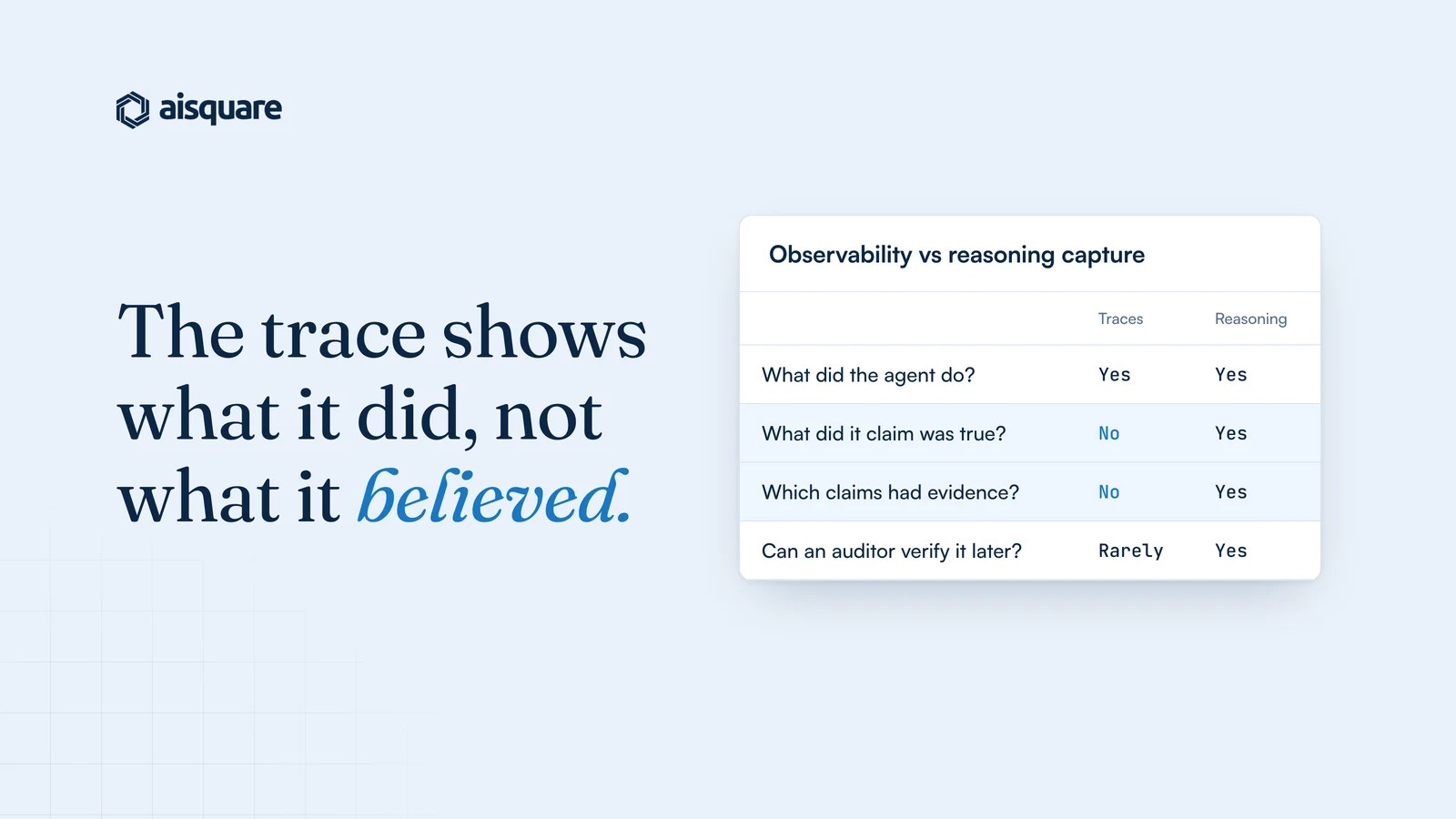
If any answer is no, your agent is observable but not yet explainable. Our post on agent observability covers the difference.
Book a demo to see an agent decision explained claim by claim.
Read next: Agentic governance: how to get agents into production and Agentic governance framework: a practical template.
Get your agents into production
AISquare captures the reasoning behind every agent decision, enforces your rules on every run, and keeps a record your risk team can check.