Agentic Governance
Agentic Governance: How to Get Agents Into Production
Agentic governance is what gets agents past risk and compliance. Learn the five controls risk teams ask for, and how to prove agents belong in production.

Senior Growth Manager
In this article — 7 sections
Most enterprise AI agents aren’t failing because they can’t do the work. They’re failing because nobody can prove they should be allowed to. That gap has a name: agentic governance. Done well, it’s the difference between an agent stuck in a review queue and one running in production.
This guide covers what agentic governance means in practice, why the usual approach stalls, and the five controls risk and compliance teams actually ask for.
Why agents stall before production
Only about 16% of large enterprises have deployed agentic AI at enterprise scale (Infosys and HFS, April 2026). AvePoint’s State of AI 2026 found that 86% of organizations delayed deployments by close to six months over security and governance. Gartner expects more than 40% of agentic AI projects to be cancelled by the end of 2027.
The agents behind those numbers are mostly built, and the capability works. They’re waiting for someone in risk or compliance to sign off, and that person has no way to see what the agent knows, which rules it follows, or why it makes the calls it makes.
Why agentic governance is harder than model governance
Model governance asks whether a model is accurate and fair on a test set. Agents raise harder questions because they act. They call tools, read live systems and chain decisions together.
Errors compound. An agent that’s 95% accurate on one step is about 60% accurate across ten steps and 36% across twenty, and most real enterprise workflows run longer than that. Agents also fail quietly: a wrong answer delivered with confidence looks the same as a right one on a dashboard.
So agentic governance can’t be a one-time review. It has to run every time the agent does.
What agentic governance actually means
A working definition: agentic governance is the set of controls that decide what an agent may do, prove why it did it, and improve how it does it over time.
Most frameworks stop at the first part. Permissions and approval gates answer "may this agent act?" They don’t answer "has this agent earned more autonomy?", and that’s the question that gets agents out of pilot.
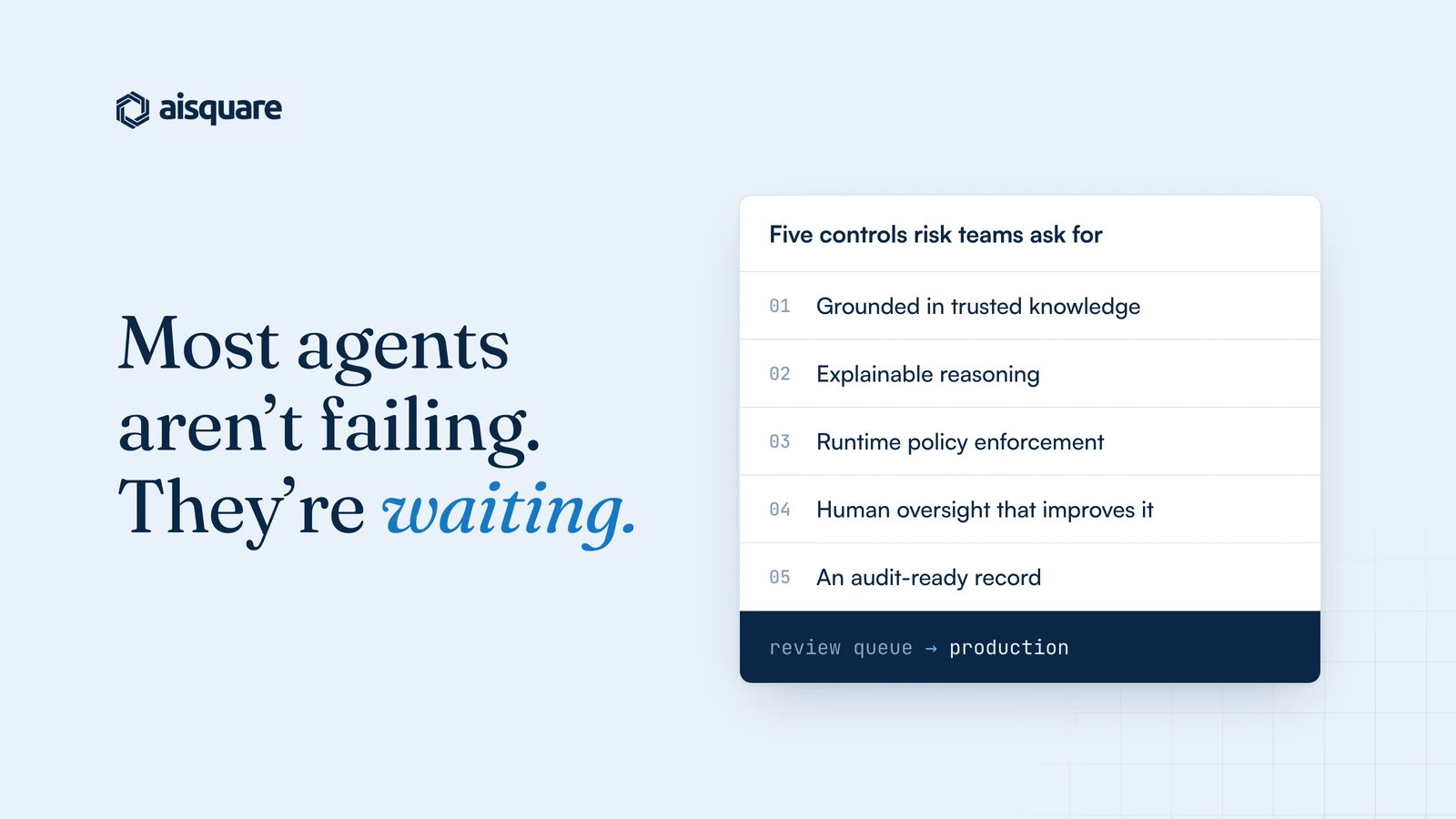
The five controls risk teams ask for
- Grounded in trusted knowledge. The agent reasons from your company’s knowledge, policies and context, not just whatever the model absorbed in training. Reviewers need to see what the agent was told.
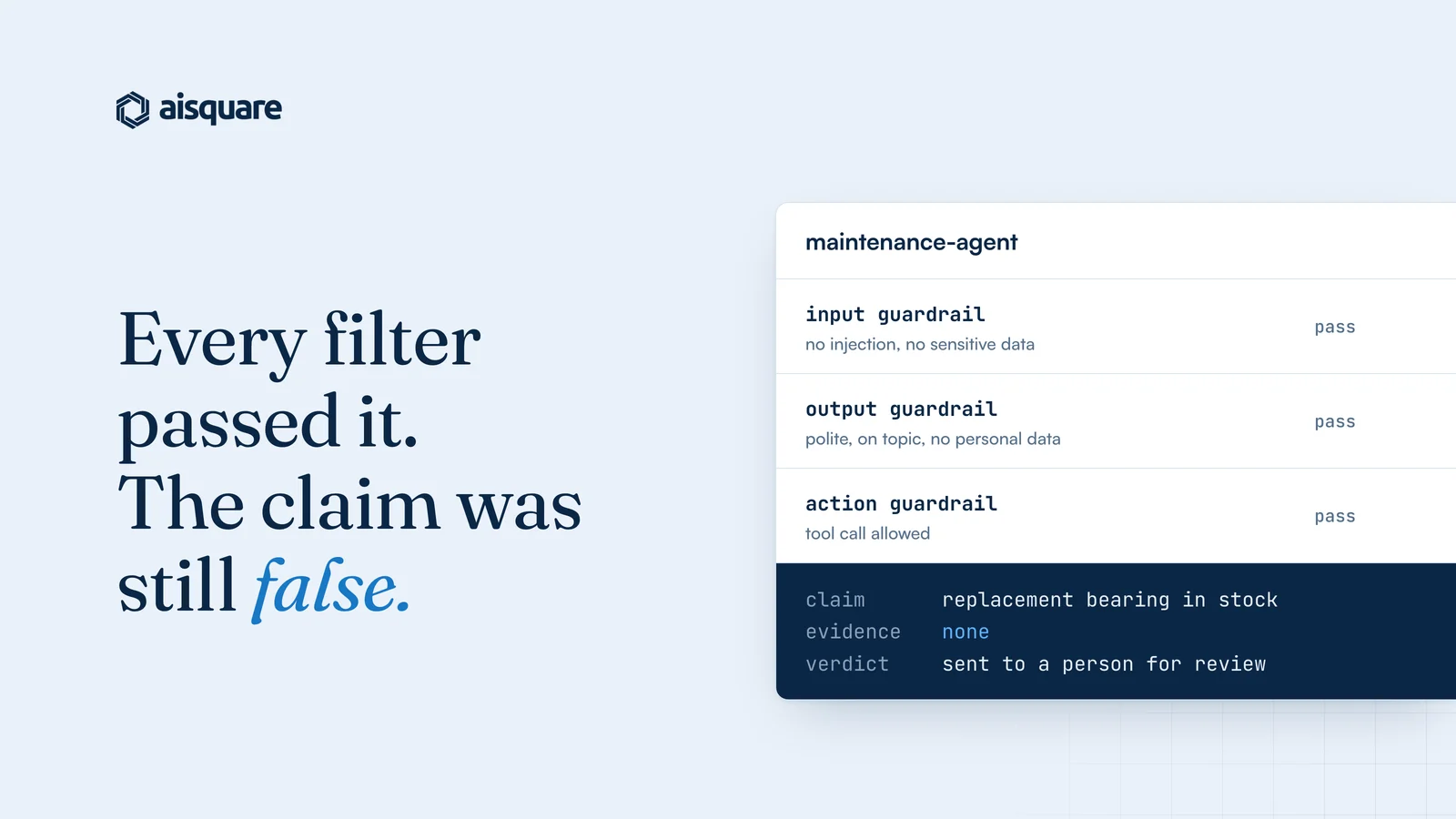
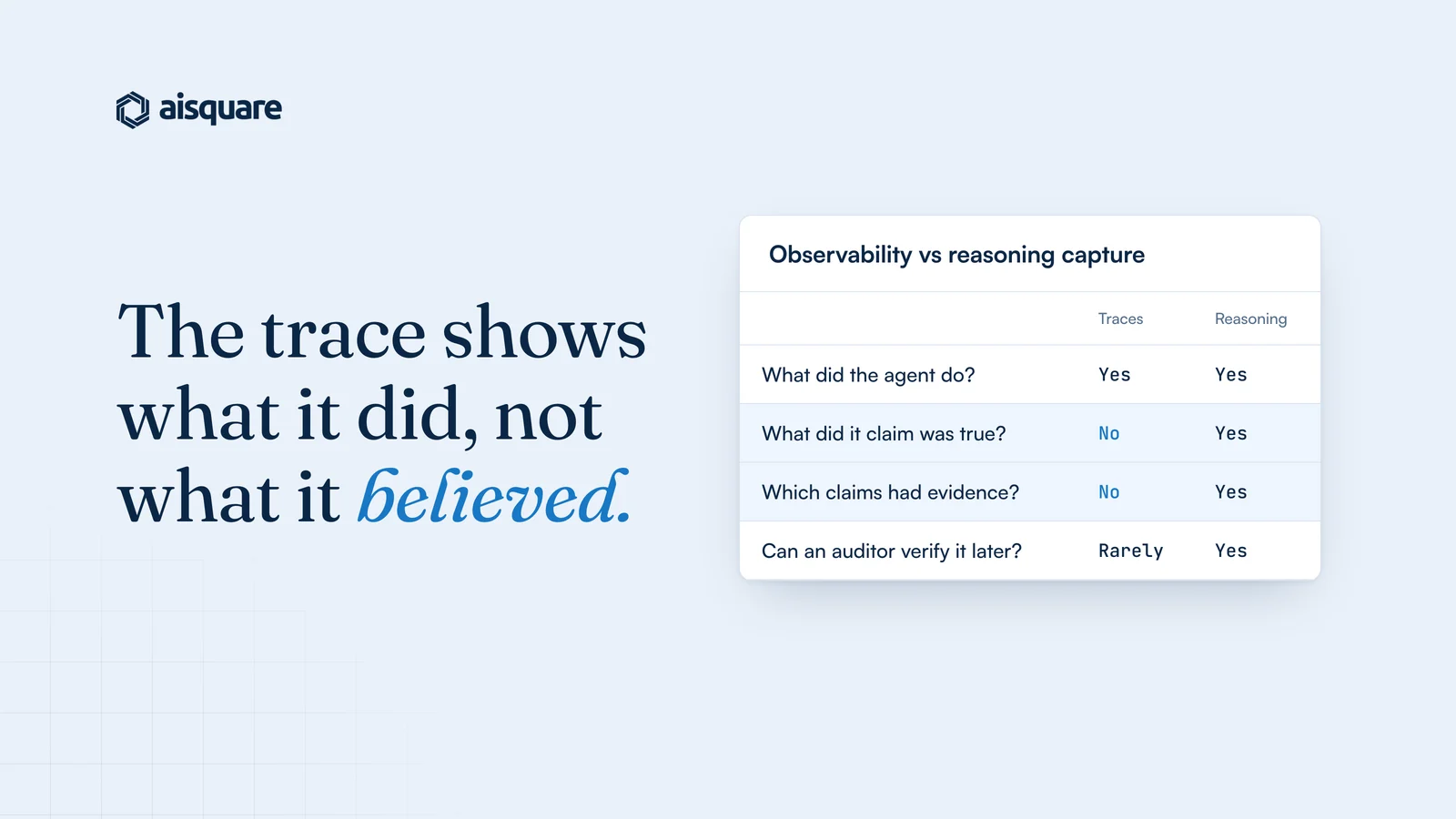
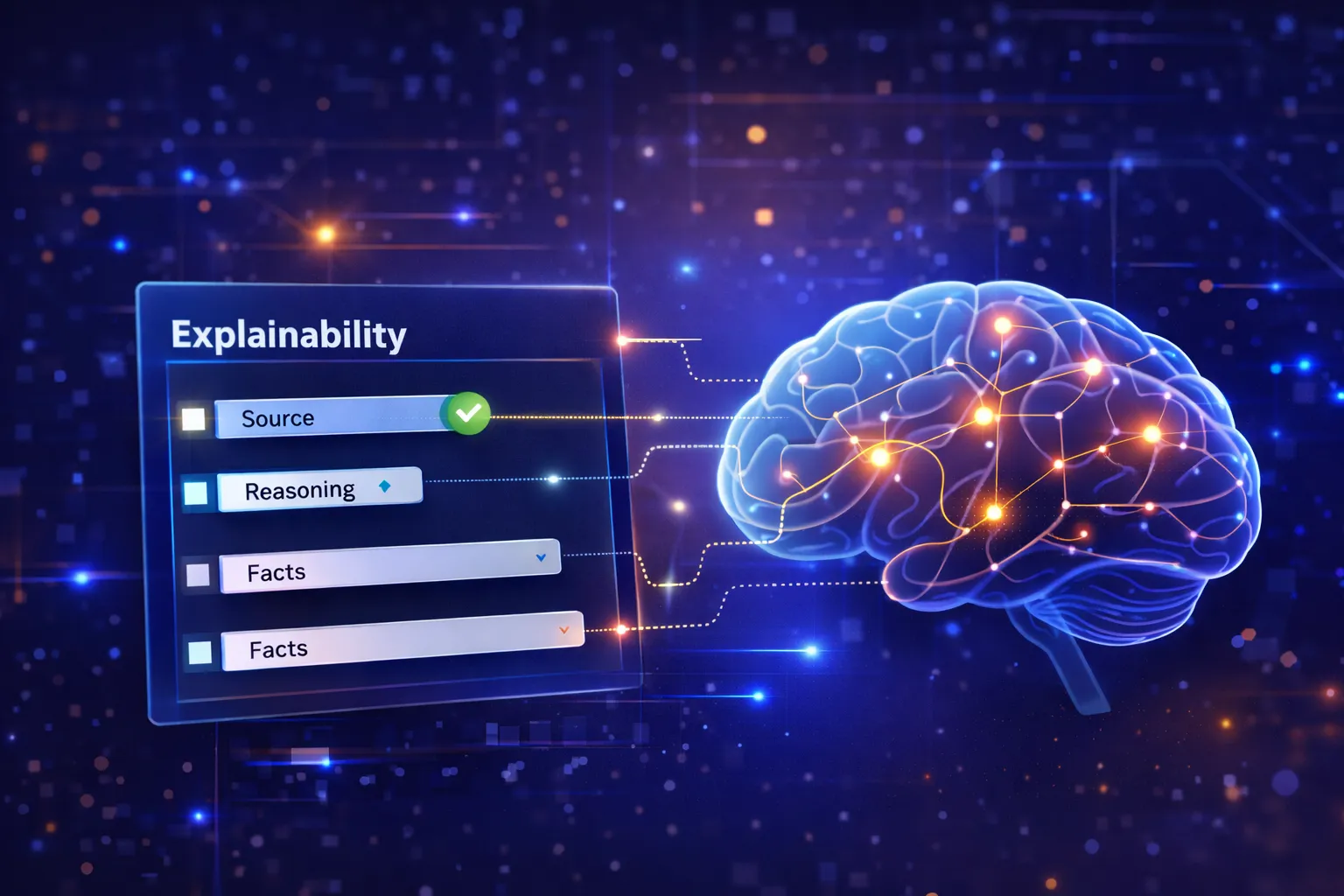
- Explainable reasoning. Logs show what an agent did. Reviewers need to know what it believed. At AISquare we capture this with RML, our Reasoning Markup Language, which breaks each decision into claims, assumptions and evidence and flags any claim your data doesn’t back.
- Runtime policy enforcement. A rule written in a document protects no one. It has to be checked on every run, before the decision goes out. If a refund agent proposes $1,250 and policy caps refunds at $500, the run is blocked and routed to a manager. Our guide to AI agent guardrails goes deeper on this.
- Human oversight that improves the agent. Approving outputs at the end of the line wears reviewers down until oversight becomes a formality, a pattern Wharton researchers have called "cognitive surrender". The better model: experts correct the reasoning, and each approved correction becomes a rule every relevant agent follows.
- An audit-ready record. Every decision needs a record a regulator can verify later: the model, tools, data and rules used, plus a signature showing nothing changed after the fact.
Map the controls to frameworks you already use
You don’t need a new rulebook. The EU AI Act, NIST AI RMF and ISO/IEC 42001 already set expectations for transparency, human oversight and record keeping. The five controls above produce the evidence those frameworks ask for, decision by decision rather than policy by policy.
A 30-day starting plan
- Week 1: list the agents in flight and pick one with a clear business owner and a real risk reviewer.
- Week 2: connect the knowledge and policies it should reason from, and write its top five rules in plain English.
- Week 3: run it with reasoning capture and runtime enforcement switched on, with experts reviewing claims instead of final outputs.
- Week 4: show your risk team the evidence: what the agent knew, what it decided, why, and every time a rule stopped it.
Agree up front what "good enough for production" means. Without that, the review never ends.
Where AISquare fits
AISquare is the Collective Intelligence Platform for Agent Trust. It works alongside the agent frameworks, observability tools and governance platforms you already run, and adds what they don’t: reasoning you can verify, rules enforced on every run, and learning that compounds from your experts.
Book a demo to see a governed agent run from start to finish.
Read next: AI agent guardrails: what they catch and what they miss and Agent observability: why traces are not enough.
Ready to build?
Turn your ideas into interactive AI experiences with the AISquare Creator Studio.
About the author
Senior Growth Manager
Senior Growth Manager at AISquare Studios, writing about what it takes to get AI agents into production: governance, guardrails and observability.